I. Current Situation Overview
The persistent geopolitical tensions in the Middle East are generating ripple effects across global supply chains. We continue to monitor developments in the region closely and maintain tight coordination with our partners and local authorities on all operational matters. Against this backdrop, ensuring the personal safety of our employees, safeguarding operational continuity, and maintaining the stable flow of our customers' supply chains remain the primary considerations underpinning every decision we make.
Despite the multiple challenges currently facing us—including port congestion and disrupted cargo flows—we are able to sustain core operations within certain constraints, thanks to our extensive regional partner network and flexible routing capabilities. By identifying alternative transport corridors and dynamically reallocating capacity, we are committed to maximising supply chain continuity in this complex environment.
1.1 Dimensions of Conflict Impact on Logistics Chains
The impact of the current regional tensions on the logistics sector is not a single-dimensional disruption but rather a multi-layered and interwoven set of challenges:
- Rerouting and diversion of ocean shipping lanes have led to significantly extended transit times, particularly on the critical corridors connecting Asia and Europe.
- Regional hub ports are experiencing intermittent congestion, with increased volatility in vessel waiting times and declining terminal productivity.
- Inland road freight is under pressure from heightened security screening and restricted border crossings at certain points, impacting cross-border transit times.
- Air freight capacity has tightened at various stages, intensifying competition for space on urgent and high-value cargo shipments.
- Insurance premiums and surcharges continue to rise, directly driving up total logistics costs.
The compounding effect of these factors has markedly increased uncertainty in supply chain planning. For importers and exporters, the traditional “fixed-schedule, fixed-volume” transport model is facing unprecedented challenges; flexibility and redundancy are fast becoming the new fundamentals of supply chain management.
II. Contingency Plans and Response Measures
In response to this complex and fast-changing situation, we have fully activated our emergency response mechanism, advancing simultaneously across five dimensions—capacity protection, route diversification, service continuity, flexible reallocation, and information transparency—to ensure our customers’ supply chains receive the greatest possible protection in a turbulent environment.
2.1 Core Response Measures
| Response Direction | Specific Measures | Expected Outcome |
|---|---|---|
| Capacity Lock-In | Prioritise space allocation for contracted customers; reserve buffer capacity on critical trade lanes | Reduce the risk of rollovers and space shortages |
| Route Diversification | Develop alternative transhipment ports and substitute transport corridors to reduce single-corridor dependency | Strengthen route resilience and shorten disruption recovery time |
| Far East Trade Lane Protection | Implement dedicated monitoring and priority resource allocation for critical Far East trade corridors | Maintain service stability on the core Asia–Europe shipping lane |
| Flexible Transhipment Solutions | Provide dynamic routing options for Middle East cargo with support for multimodal switching | Ensure cargo can rapidly find an alternative path following disruption |
| Proactive Rate and Surcharge Communication | Proactively communicate freight rate changes and surcharge adjustments to customers | Help customers budget accurately and make timely decisions |
2.2 Coordinated Support from Our Global Team
Our global operations team is working around the clock, 24/7, focused on identifying certainty within uncertainty. For each shipment—whether time-sensitive retail goods, temperature-controlled pharmaceutical products, or oversized industrial equipment—we tailor a differentiated delivery plan based on the urgency and characteristics of the cargo. This “shipment-by-shipment” precision operating model is a critical capability for safeguarding our customers’ interests in an unpredictable environment.
III. Impact Analysis on Key Trade Corridors
3.1 Asia–Europe Maritime Corridor
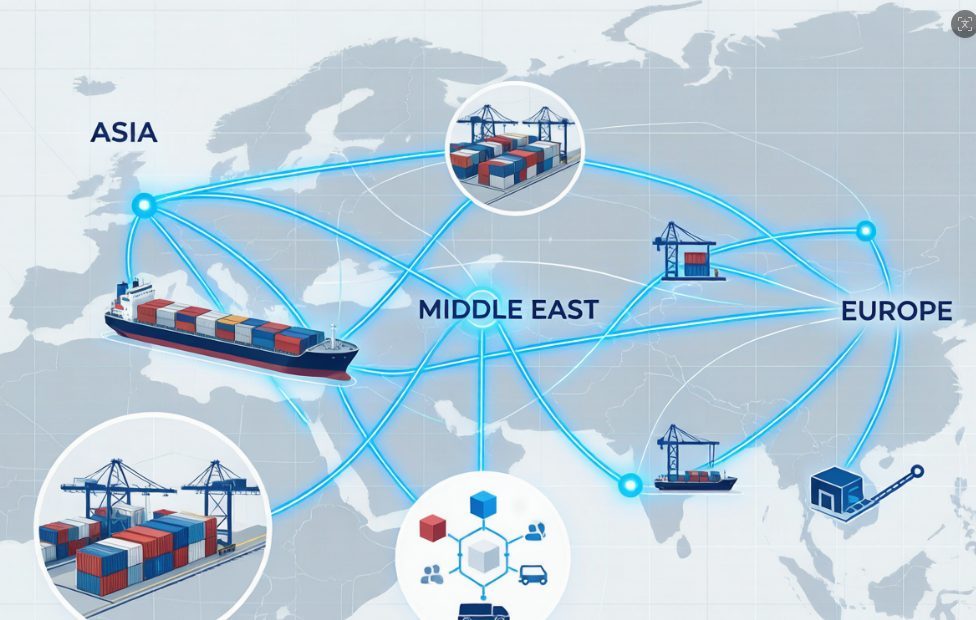
The Middle East situation has had the most direct impact on the Asia–Europe trade corridor. Traditional routes via the Red Sea and the Suez Canal are under pressure to divert around the Cape of Good Hope, adding 10 to 15 days to one-way transit times, with fuel costs and carbon emissions rising in parallel. Some carriers have begun reassessing their network configurations, incorporating more diversion options as regularised alternatives rather than temporary contingency measures. This places greater inventory buffer requirements on companies that rely on just-in-time (JIT) production models.
3.2 Intra-Regional Transport in the Middle East
Road freight and short-sea shipping within the Middle East are also under strain. Cross-border land transport faces stricter security screening procedures and restricted access at certain border crossings, increasing uncertainty in transit times. Cargo flows between Gulf Cooperation Council (GCC) member states remain relatively stable, but routes that pass near conflict-affected zones require additional risk assessments and security contingency plans.
3.3 Air Freight as an Alternative
As ocean transit times lengthen, certain high-value, time-sensitive cargo is shifting to air freight. This has led to tightening cargo capacity at major Middle Eastern air hubs, with freight rates remaining at elevated levels. For shippers who cannot absorb ocean delays but also need to control their budgets, the Sea-Air hybrid solution is emerging as a popular middle ground—goods are first shipped by sea to a Middle Eastern hub and then transferred to air for the final leg to the destination.
IV. Implications and Outlook for Supply Chain Management
4.1 Short-Term Recommendations
In the current environment, we recommend that businesses take action in the following areas to strengthen their supply chain resilience:
- Advance planning: incorporate transport lead-time uncertainty into procurement and production schedules, and allow a buffer of 2–3 weeks.
- Multi-source strategy: avoid over-reliance on a single shipping lane or port, and explore the feasibility of alternative transport options.
- Inventory optimisation: maintain higher safety stock levels where appropriate, especially for critical raw materials and best-selling finished goods.
- Information connectivity: establish closer information-sharing mechanisms with logistics partners to ensure you receive situation updates at the earliest opportunity.
- Cost forecasting: build flexibility into financial budgets for transport surcharges and insurance cost increases.
4.2 Medium- to Long-Term Outlook
The geopolitical landscape in the Middle East is unlikely to improve fundamentally in the short term, and the trend towards supply chain “fragmentation” may deepen further. From a medium- to long-term perspective, the following developments merit close attention:
- Supply chain regionalisation: more companies may accelerate nearshoring or friend-shoring strategies to shorten the geographic span of their supply chains.
- Multimodal upgrades: the strategic value of rail freight (e.g. the China–Europe Railway Express) and Sea-Air hybrid models will become increasingly prominent.
- Digital resilience: real-time tracking, predictive analytics, and intelligent dispatching systems are evolving from a “nice-to-have” to a “must-have”.
- Insurance and risk management: demand for supply chain disruption insurance will grow substantially, and enterprise risk management frameworks will need systematic upgrading.
For all participants in global trade, the Middle East situation serves as a renewed reminder: supply chain competitiveness depends not only on cost and efficiency but, more importantly, on the resilience to keep operating in the face of uncertainty. Companies that can rapidly detect risks, adapt their strategies flexibly, and execute contingency plans effectively will gain an early advantage in this ongoing test.
V. Contact and Support
We understand that every shipment carries our customers’ business commitments and market reputation. Our global team stands ready to provide tailored transport solutions and real-time situation updates. Whether you are dealing with urgent cargo redirection, alternative route assessment, or comprehensive cost analysis, please contact your local account representative for expert support at any time.
“In times of uncertainty, the speed of information and the quality of decisions define supply chain resilience. We are committed to helping every customer navigate the fog with the most transparent communication and the most agile response.”
Disclaimer: This report has been prepared based on publicly available information and industry analysis as of May 2026. It is provided for reference only and does not constitute business or investment advice. The situation is evolving rapidly; we recommend that all judgements be informed by the latest intelligence available.